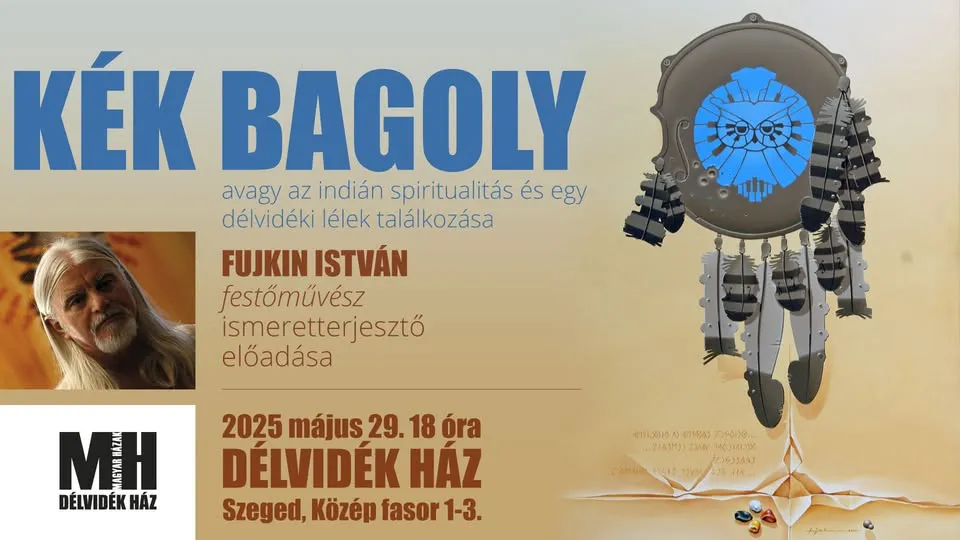
Blue Owl - or the encounter of Indian spirituality and a Southern soul
If you're unsure about the language or anything else regarding the event, please contact the event organizer for confirmation.
In order to show the art of István Fujkin in its entirety, we would like to introduce the interested persons to the Blue Owl series after the passing art album. If we want to describe his work with a single sentence, we should say that he is first touched by music, whether it be the song or instrumental composition, confesses himself to the painter István Fujkin of Horgos, who has been taking his musical inspiration since 1974.
In the beginning, music was just a sound curtain, which filtered and swept through the noises of the outside world. Later, a specific musical element appeared more and more often in a picture of me. Although inspiration is always a specific piece of music, I do not consider the visual world as mere illustration. For example, the painted instruments begin a new life in the given environment, and slightly re-compose the songs that triggered their birth in one of their interviews, even at the beginning of their career.
István Fujkin moves to Canada after Hungary in the wake of new artistic challenges. The music further inspires him there in the creation of his works. His art, like Fujkin, is becoming more known.
He learns about Indian culture in Canada, and many of its elements, tools, and spirituality, the history and musical tradition of the Indians, capture his artistic imagination. The most promising fruit of his Canadian work is the Blue Owl, which connects the elements of Indian culture and tradition in a new and unusual way with the visual world of today's man. On 29 May 2025, the artist, István Fujkin, presented this series of images with musical inspirations associated with it, with the beginning of a visual performance at 18 o'clock.
In an interview about the series of images, he said:
I wondered how much I could touch this culture in such a way that it wasn't the usual Indian romance, but something else, and how much else could I be entitled to deal with it? After that, I finally thought that my Vojvodina origin gave me the opportunity to experience in part, at least, what it was like to be a stranger in our own homeland. We didn't just have to imagine what it was like for them, but we did experience it a little bit, although our fate is not entirely comparable to theirs, because we still feel the oppression in their direction. However, this fact has already given me the right to touch the subject in a way that gives it its own form.
Everyone's welcome.